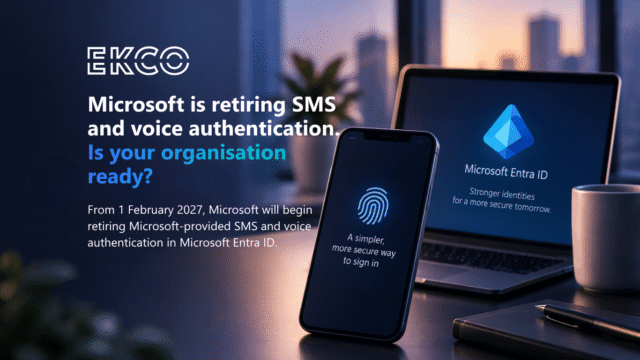
Microsoft is retiring SMS and voice authentication. Is your organisation ready?
From 1 February 2027, Microsoft will begin retiring Microsoft-provided SMS and voice authentication in Microsoft Entra ID.
By Edward Stubbs, Modern Workplace Consultant, Ekco Cloud & Security
From 1 February 2027, Microsoft will begin retiring Microsoft-provided SMS and voice authentication in Microsoft Entra ID. Organisations relying on these methods need to prepare now to avoid disruption and strengthen their identity security.
As part of its continued move towards passwordless, phishing-resistant authentication, Microsoft is changing how organisations verify user identities.
The change marks a significant shift away from traditional authentication methods, such as one-time codes sent by text message or automated phone calls, towards more secure alternatives, including passkeys and Windows Hello for Business.
For organisations still relying on SMS and voice authentication, the deadline is approaching. But this isn’t simply about replacing an existing authentication method. It’s an opportunity to rethink how users access business systems, reduce security risks and build a stronger foundation for identity protection.
What’s changing and when?
Microsoft has confirmed that it will retire its native SMS and voice authentication services in Microsoft Entra ID, with the changes taking effect in stages.
The key dates organisations need to be aware of are:
- 1 September 2026: Microsoft began automatically enabling passkeys for users configured to use SMS or voice authentication, encouraging them to register stronger authentication methods.
- 1 February 2027: Microsoft-provided SMS and voice authentication will be retired for most users.
- 1 July 2027: The retirement will extend to Global Administrators and external users.
Don’t leave your authentication security to Microsoft’s default settings.
Microsoft’s default passkey policy prioritises compatibility, but it may not align with your organisation’s security requirements. Without reviewing these settings, you risk allowing passkeys to be stored in unapproved locations. Speak to Ekco to ensure your transition is secure, controlled and aligned with your business needs.
Importantly, Microsoft isn’t removing SMS and voice authentication entirely. Organisations with a genuine requirement to retain these methods will need to transition to a supported third-party telephony provider through Microsoft Security Store.
However, for most organisations, Microsoft’s direction is clear: stronger, phishing-resistant authentication should become the standard.
Why is Microsoft making this change?
Cybercriminals are increasingly targeting user identities as a way into business systems. And while traditional multifactor authentication (MFA) provides an additional layer of protection, not all authentication methods offer the same level of security.
SMS codes and voice calls have historically been widely used because they’re familiar, accessible and relatively straightforward to implement.
However, they also have weaknesses.
Telephony based authentication can be vulnerable to SIM-swapping attacks, where criminals gain control of a user’s mobile number. One-time codes can also be intercepted or stolen through phishing, while attackers can manipulate users into sharing verification codes.
This means that even organisations using MFA can remain exposed to identity-based attacks.
Phishing-resistant authentication addresses these weaknesses by making it significantly harder for attackers to steal or misuse authentication credentials.
Methods such as passkeys and Windows Hello for Business use cryptographic authentication rather than relying on codes that users must receive and enter.
The result is stronger protection against phishing and credential theft, alongside a simpler and more seamless sign-in experience for users.
Microsoft’s decision reflects a wider shift in cyber security: moving beyond simply verifying identities towards making authentication itself more resistant to attack.
What does this mean for your organisation?
If your organisation currently uses Microsoft-provided SMS or voice authentication, you’ll need to assess how the retirement affects your users and existing security policies.
The most immediate concern is maintaining access.
Users who rely exclusively on Microsoft-provided SMS or voice authentication will need an alternative supported method to continue authenticating after the applicable retirement date.
However, the impact extends beyond individual users.
Many organisations have authentication policies that have evolved over time, often with different methods enabled across departments, devices and user groups.
This can create inconsistencies and make it difficult to understand where legacy authentication methods are still being used.
Before making changes, organisations should consider several important questions:
- Who is affected? Do you know how many users currently rely on SMS or voice authentication?
- Are your existing policies fit for purpose? Do they support stronger authentication methods, or are they still dependent on legacy approaches?
- What alternatives are appropriate? Would passkeys, Windows Hello for Business or other supported methods work best for your users?
- Are there genuine telephony requirements? Do certain users, systems or business processes still need SMS or voice authentication?
- How will you manage the transition? Can you introduce new authentication methods without disrupting day-to-day operations?
It’s also important to consider processes such as self-service password reset, which may be affected by the retirement of Microsoft-provided telephony authentication.
Addressing these questions early will help organisations avoid a rushed transition and make more informed decisions about their long-term authentication strategy.
The risk of leaving Microsoft to manage the transition
While Microsoft’s automatic passkey registration campaign is designed to minimise disruption, organisations shouldn’t rely on it as a substitute for a controlled, organisation-led rollout.
Microsoft’s default passkey policy prioritises broad compatibility, which may not align with your organisation’s security requirements. Without reviewing and configuring these settings, you risk allowing users to register and store passkeys in locations that haven’t been approved by your business.
Taking ownership of the transition is essential. Organisations should establish clear policies around where passkeys can be stored, which authentication methods are permitted and what security controls need to be in place before users begin registering them. Without the right preparation, organisations could face unnecessary disruption, increased IT support requests and difficulties accessing business-critical applications.
Why this is an opportunity to modernise your authentication strategy
While Microsoft’s retirement deadline creates an immediate requirement for action, organisations should look beyond simply maintaining access.
Replacing SMS with another authentication method may address the short-term challenge, but it doesn’t necessarily deliver the strongest security outcome.
Instead, organisations have an opportunity to take a more strategic approach to identity security.
Moving towards phishing-resistant authentication can deliver several important benefits:
- Stronger protection against identity-based attacks: Reducing reliance on passwords and one-time codes helps protect users against phishing, credential theft and account compromise.
- A simpler user experience: Passwordless authentication methods can make signing in easier, reducing the need to remember passwords or wait for verification codes.
- Greater consistency across your organisation: Reviewing existing authentication policies provides an opportunity to standardise how users access applications and services, reducing unnecessary complexity.
- A stronger foundation for future security requirements: As cyber threats evolve, organisations need authentication strategies that can adapt. Moving towards phishing-resistant methods supports a more resilient, long-term approach to identity protection.
The key is to treat Microsoft’s announcement as more than a technical deadline. It’s an opportunity to improve both security and the experience of accessing business systems.
How Ekco can help you prepare
With the February 2027 deadline approaching, now is the time to understand your exposure, identify affected users and establish a clear transition plan.
At Ekco, we help organisations navigate Microsoft’s changing technology landscape, ensuring they understand what’s changing, how it affects their business and what action they need to take.
Our Authentication Modernisation service provides a structured review of your existing authentication environment and a clear path towards stronger, phishing-resistant authentication.
Working with your organisation, we’ll help you:
- Understand your exposure: Assess your existing authentication environment and identify users relying on SMS and voice.
- Define the right authentication strategy: Recommend appropriate methods, including Windows Hello for Business and passkeys, based on your security requirements and user needs.
- Reduce reliance on legacy authentication: Identify opportunities to strengthen security while accounting for genuine business requirements to retain telephony authentication.
- Implement a controlled transition: Deploy, test and validate the agreed approach, helping users move to stronger authentication ahead of Microsoft’s deadline.
Our approach goes beyond addressing the immediate retirement. We help organisations establish a more consistent, secure and future-ready authentication strategy.
The outcome? Stronger identity security, reduced reliance on legacy authentication and a clear path towards passwordless working.
Need to retain SMS or voice authentication?
We recognise that not every organisation will be ready to move entirely away from SMS and voice authentication before Microsoft’s deadline.
Some businesses may have operational, technical or regulatory requirements that make retaining these methods necessary.
For organisations that need a more immediate solution, Ekco offers a focused Telephony Authentication Transition service.
This service helps organisations assess their existing telephony authentication requirements and transition to an appropriate supported provider, maintaining access to SMS and voice authentication beyond Microsoft’s retirement deadline.
It provides a practical route to addressing the immediate change without requiring a wider authentication modernisation project.
Don’t leave your authentication strategy until the deadline
Microsoft’s retirement of SMS and voice authentication is another important step towards a more secure, passwordless future.
For organisations still relying on these methods, preparation is essential. Waiting until the deadline could introduce unnecessary disruption and leave limited time to evaluate the most appropriate alternatives.
By acting now, you can take control of the transition, strengthen your security posture and ensure your users are prepared for what’s next.
Ready to prepare for Microsoft’s authentication changes?
Speak to Ekco about our Authentication Modernisation and Telephony Authentication Transition services. We’ll help you understand your exposure, identify the right approach and make the transition with confidence.
Learn more about the latest Microsoft changes affecting your organisation, and what to do about them.

Question?
Our specialists have the answer