Ireland EU Presidency 2026: Cyber Security Risks and What Organisations Should Do
Written by: Dominic Kearne
From July to December 2026, Ireland holds the Presidency of the Council of the European Union for the eighth time. It is a significant moment for the country, placing Ireland at the centre of EU decision-making during a period of genuine geopolitical uncertainty.
That visibility brings opportunity. It also brings elevated cyber security risk, for government institutions and for the wider Irish business community.
This piece sets out what that risk looks like, what history tells us to expect, and the practical steps organisations should consider before and during the presidency period.
Why Ireland’s EU Presidency Increases Cyber Risk
When a country holds the EU Presidency, it becomes a more attractive target. Government systems, diplomatic communications, and organisations connected to EU operations carry greater intelligence value. The interest is not hypothetical. It is a pattern that has repeated itself across previous presidencies.
State-linked threat groups associated with Russia, China, and Iran routinely conduct cyber espionage, credential theft, ransomware, and disruptive operations against European governments and critical infrastructure. During a presidency, a host nation’s communications and systems represent a higher-value target for hostile intelligence services and advanced persistent threat (APT) groups.
Ireland’s exposure across diplomatic, cyber, and intelligence domains is expected to increase over this period.
The Specific Cyber Threats Irish Organisations Face
State-Aligned Threat Activity
APT groups operating on behalf of state interests will likely show increased interest in Irish government systems, political communications, sanctions-related discussions, and meeting schedules. The goal is typically intelligence gathering, though disruption and data theft are also common objectives.
Phishing and Social Engineering
Periods of high international visibility tend to bring a rise in targeted phishing, executive impersonation, and social engineering campaigns. Attackers increasingly use AI-generated content to make these approaches appear credible and locally relevant. Government departments, their suppliers, and professional services firms are common targets.
Supply Chain and Third-Party Exposure
Cyber risk does not stop at the boundary of government. Organisations across transport, healthcare, technology, manufacturing, and pharmaceuticals could face increased attention from state-aligned and financially motivated threat actors. Attackers frequently seek indirect access through trusted suppliers, cloud providers, and managed service partners connected to higher-value environments.
Hacktivism and Disruption
Politically motivated hacktivist groups may attempt disruptive activity against public-facing websites, APIs, and online services. Even low-sophistication attacks can cause operational disruption and reputational damage, particularly during high-profile events with international media attention.
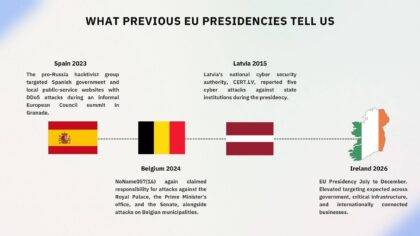
What Previous EU Presidencies Tell Us
History is instructive here.
Spain, 2023. During Spain’s EU Presidency, the pro-Russia hacktivist group NoName057(16) targeted Spanish government and local public-service websites with DDoS attacks during an informal European Council summit in Granada. The attacks coincided directly with Spain’s visible support for Ukraine.
Belgium, 2024. Belgium experienced repeated cyber targeting of public-sector institutions around the period of its EU Presidency. NoName057(16) again claimed responsibility for attacks against the Royal Palace, the Prime Minister’s office, and the Senate, alongside attacks on Belgian municipalities.
Latvia, 2015. Latvia’s national cyber security authority, CERT.LV, reported five cyber attacks against state institutions during the presidency. The incidents coincided with ministerial meetings and other presidency-related events, suggesting deliberate targeting linked to Latvia’s elevated international profile.
The Stryker incident, Ireland 2026. In March 2026, the Iran-linked group “Handala” claimed responsibility for a significant cyber attack on MedTech company Stryker, resulting in the shutdown of the company’s Cork manufacturing base, its largest facility outside the United States. While not directly linked to the presidency, the incident is a clear illustration of how geopolitical cyber activity can reach Irish organisations through international business connections.
The pattern across each of these cases is consistent: a country’s EU Presidency role increases its attractiveness as a target, and the risk extends beyond government to internationally connected businesses.
Ireland’s Cyber Security Posture
Ireland has continued to strengthen its national cyber security position in the lead-up to the presidency. Investment in cyber resilience, critical infrastructure protection, and national incident response has increased, with the National Cyber Security Centre (NCSC) Ireland playing a central coordinating role.
The NCSC provides threat intelligence, incident response support, and security guidance to government departments, critical service providers, and businesses across Ireland. During the presidency, closer collaboration between government, EU institutions, the private sector, and international security partners is expected.
The emphasis is on prevention, rapid incident response, resilience testing, and the protection of critical national infrastructure across sectors including transport, healthcare, finance, technology, telecoms, and energy.
How Organisations Should Prepare
The level of risk will vary by sector and by how closely an organisation is connected to government or EU-related activity. That said, strong foundational security controls matter for every organisation, regardless of size or sector.
The following measures are worth prioritising before and during the presidency period:
- Employee awareness. Ensure staff are alert to phishing, impersonation attempts, and social engineering. Threat activity of this type typically increases during high-profile geopolitical events.
- Continuous threat monitoring. Real-time visibility across your environment is essential for detecting suspicious activity early.
- Patch and vulnerability management. Known vulnerabilities remain one of the most common entry points for attackers. Timely patching reduces that exposure.
- Endpoint protection. Strong controls at the device level are a baseline requirement.
- Multi-factor authentication. MFA should be enforced across all externally accessible services without exception.
- Incident response readiness. Review and test your incident response procedures now, before an incident occurs.
- Supplier and third-party assurance. Understand your supply chain exposure and strengthen assurance processes where gaps exist.
Cyber resilience depends on more than technology alone. Effective defence requires visibility, rapid response capability, informed decision-making, and a strong security culture throughout the organisation.
How Ekco Can Help
As an Irish managed security services provider, Ekco supports organisations in building the detection, response, and resilience capabilities that genuinely matter during periods of elevated cyber risk.
That means advanced security tooling, AI-driven threat detection, threat intelligence, 24/7 Security Operations Centre (SOC) monitoring, and incident response expertise, delivered as an integrated service.
If your organisation wants to review its cyber resilience ahead of the presidency period, we are happy to start that conversation.
Frequently Asked Questions
1. What cyber risks does Ireland face during the EU Presidency? Ireland faces elevated risk from state-aligned cyber espionage, targeted phishing and social engineering, supply chain attacks, and politically motivated hacktivist activity. Government systems, diplomatic communications, and internationally connected businesses are the most likely targets.
2. Which threat actors are most likely to target Ireland during the presidency? State-linked threat groups associated with Russia, China, and Iran are the most commonly cited actors in relation to European government targeting. Hacktivist groups, particularly those with pro-Russia affiliations, have a documented history of targeting EU Presidency countries.
3. Has an EU Presidency country been targeted by cyber attacks before? Yes. Spain, Belgium, and Latvia all experienced cyber incidents during or around their EU Presidency periods. In each case, the attacks were linked to the country’s elevated geopolitical visibility and, in several instances, its position on the war in Ukraine.
4. What should Irish organisations do to prepare? Prioritise employee awareness training, continuous threat monitoring, MFA enforcement, robust endpoint protection, patch management, incident response readiness, and supplier assurance. Organisations with limited internal security resources should consider working with a managed security services provider.
5. What is the NCSC’s role during the presidency? The National Cyber Security Centre (NCSC) Ireland coordinates national cyber defence, provides threat intelligence and incident response support, and issues security guidance to government departments and businesses. It is expected to play a central role in Ireland’s cyber security posture throughout the presidency.
6. What sectors are most at risk? Transport, healthcare, technology, manufacturing, pharmaceuticals, finance, telecoms, and energy are identified as sectors that may face increased attention from both state-aligned and financially motivated threat actors during this period.

Question?
Our specialists have the answer