Before you buy any AI tool, audit what you’re already paying for
By Colin Riddle, Chief Product Officer, Ekco Cloud & Security
There’s a version of the AI conversation happening in almost every boardroom right now, and it usually starts in the wrong place. Someone asks what the organisation is doing about AI. The answer that follows is a list of tools – Copilot licences, an AI agent pilot, maybe a chatbot on the website. Budget gets discussed. A rollout timeline gets sketched. And underneath all of it sits a question nobody’s asked:
What is the cloud estate we already have actually costing us, and is it working as hard as it should be?
That question matters more than it looks
In every FinOps assessment we run, the pattern is remarkably consistent – not because organisations are careless, but because cloud spend accumulates the way any recurring cost does: quietly, and mostly without anyone deciding it should. A resource gets provisioned for an initiative that wrapped up eighteen months ago and is no longer in use. Tagging is inconsistent enough that nobody can say with confidence which department owns which line item. Infrastructure gets sized for a peak load that happens twice a year and then runs at that size every single day in between.
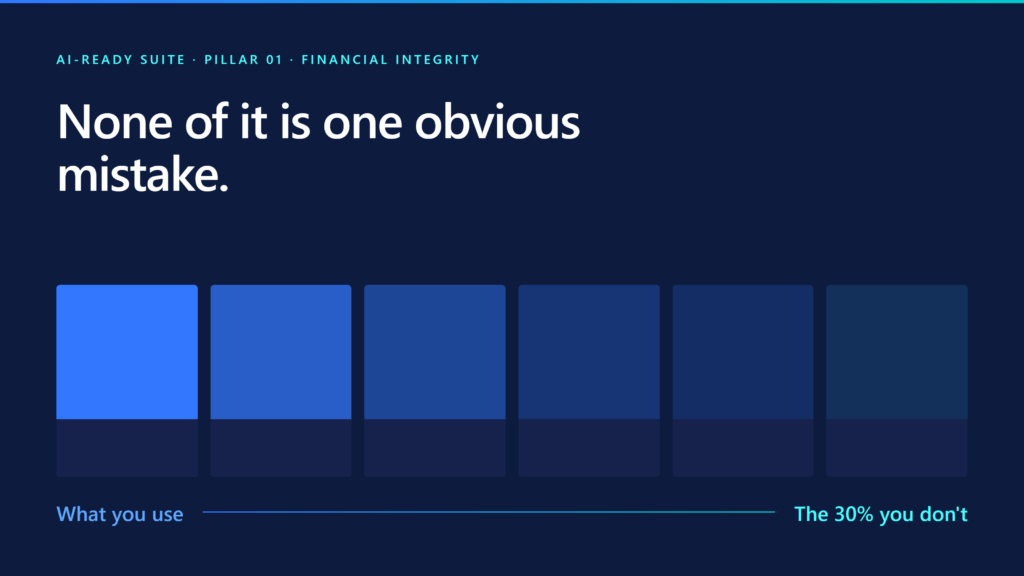
None of this shows up as a single obvious mistake. It shows up as a slow leak that nobody’s specifically responsible for finding.
It could help pay for itself
Here’s the part that should change how organisations sequence their AI conversations: based on what we’re seeing in the market, we estimate that approximately 30% of cloud spend could be going to waste. That’s not a rounding error.
For a mid-sized organisation, that’s very often enough, on its own, to help fund the next stage of an AI-readiness roadmap – the data governance work, the security hardening, the Copilot readiness review – without a single pound of new budget being approved.
That reframes the order of operations. The instinct is to treat “get AI-ready” as a cost to be justified. It’s closer to the truth to treat it as an audit that pays for itself, provided you start in the right place. Financial governance isn’t the exciting part of an AI strategy. It’s the part that funds the exciting part.
You’ll need this evidence eventually anyway
There’s a second, quieter benefit to doing this work early, and it’s one that matters more the more scrutiny an organisation is under. A documented, evidence-based account of cloud spend and governance – who has access to what, what’s tagged to which cost centre, what the actual utilisation looks like against what’s provisioned – is exactly the kind of artefact that a board, an auditor, or increasingly a regulator, will eventually ask for.
Building it now, as part of an AI-readiness exercise, is a considerably better position to be in than producing it under pressure later.
It doesn’t take long to find out
None of this requires a large commitment to find out. A focused review of cloud cost governance and spend – typically a matter of days, not months – will tell you specifically where the leakage is and what funding for the next stage of AI readiness could look like for your organisation.
Ekco’s Azure FinOps & Cost Governance Assessment does exactly this, alongside an Infrastructure Modernisation Assessment for organisations still carrying meaningful on-premises technical debt.
Where the AI conversation should actually start
The AI conversation your board wants to have is a legitimate one. It just tends to start two steps too late. Start with what you’re already spending, and the rest of the roadmap often turns out to be more affordable than anyone expected.
And why not sign up for our short webinar series on how to get AI-Ready?
Four short webinars available to watch live or on demand after each session.


Question?
Our specialists have the answer