Most IT is built for an average working day. Fee-earner firms don’t run on average working days.
Infrastructure built around how fee-earner firms actually work, proven in every acquisition and every peak season it absorbs without breaking.
Where the friction actually costs you
Slow logins, a DMS that lags at the worst moment, a CRM and billing system that don’t talk to each other: none of it looks serious on its own. Add it up across a firm of a hundred fee earners and it stops looking small.
Modelled on two lost hours per fee earner per month, that’s an estimated £100k-£150k in billing capacity a year, an illustrative figure based on headcount and utilisation modelling, not a measured customer finding, but a useful sense of scale for what invisible friction actually costs.
It gets worse at the most challenging times. January self-assessment, April audit season,
transaction completions: fee-earner firms don’t run on an average working day, they run on peaks, and most IT was never designed around them.
Growth by acquisition adds another layer. Every new deal brings new users, new systems, sometimes an entirely different tech stack, that the platform has to absorb without straining what’s already there. Leave that unmanaged and the numbers stack up fast: three finance systems, two HR platforms, three CRMs, and no clean way to switch any of them off. Integrating at the point of acquisition, rather than after, gives you a defined off-ramp to retire duplicate systems, and their costs, on a set timeline.

Built for peaks, not averages
Our cloud and infrastructure solutions are built on Microsoft Azure, a platform engineered to run at global scale with the resilience, flexibility and scalability that demands. We design infrastructure around the way fee-earner firms actually work: outcome-first architecture that holds under January’s self-assessment crunch or April’s audit season, not just on a quiet day. That means phased, non-disruptive modernisation, stabilise first, then optimise, so change doesn’t cost the firm the billable time it’s meant to protect. And it means building for the acquisition that’s already planned, not just the estate that exists today.
Who this is for
- Managing Partners weighing the cost of disruption against the cost of standing still.
- COOs accountable for utilisation and peak-period delivery.
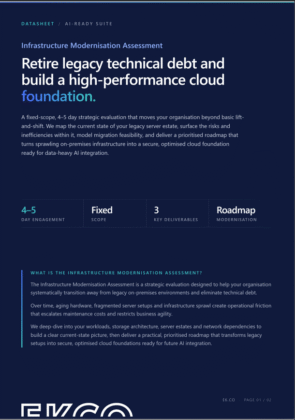
Infrastructure Modernisation Assessment
A fixed-scope, 4–5 day assessment. We do the heavy lifting, whilst your team’s time is limited to a short kickoff and a handful of targeted check-ins. A structured review of your platform and infrastructure, built around your actual workload patterns, with a prioritised roadmap at the end.
This datasheet explains what’s involved in the assessment. It sets out what we look at, what you get at the end, and how the engagement runs.
Learn more about the assessment
Book an Infrastructure Modernisation Assessment
How we help our customers

How Essex Court Chambers modernised their infrastructure with Azure

Essex Court needed a partner to enable them to migrate away from legacy infrastructure, improve reliability, reduce costs, and do…
Read more

High-performance forensics cloud for FRP Advisory

A trust-based partnership fuelling success for Gray’s Inn Tax Chambers

Trust, care and meaningful advice has formed the basis of the relationship between Ekco and Gray’s Inn Tax Chambers.
Read more